
How to Set Stop Loss Like a Pro is one of the most important skills every serious trader must master. No indicator, pattern, or market insight can save a trader who does not control risk. Mark Minervini and William O’Neil—two of the most respected growth investors and traders in the world—place stop-loss discipline at the absolute core of their success. While their approaches differ in execution, the philosophy remains the same: protect capital first, profits later.
In this article, we’ll break down Minervini and O’Neil stop-loss methods in detail, explain the psychology behind them, and show you how to apply these rules practically—especially if you trade growth stocks, breakouts, or momentum setups.
Why Stop Losses Matter More Than Entries
Most traders obsess over entries—breakout levels, indicators, news, or chart patterns. Professionals obsess over exits. The reason is simple: losses compound faster than gains. A 50% loss needs a 100% gain just to break even.
Mark Minervini often says that being wrong is inevitable; staying wrong is optional. William O’Neil echoes this by stating that the whole secret to winning in the stock market is to lose the least amount possible when you’re wrong.
That’s the foundation of How to Set Stop Loss Like a Pro.
Mark Minervini’s Stop Loss Method (The Volatility-Aware Approach)
Mark Minervini, a U.S. Investing Champion with triple-digit annual returns, uses a highly precise, rules-based stop-loss framework designed to protect capital while allowing winners to run.
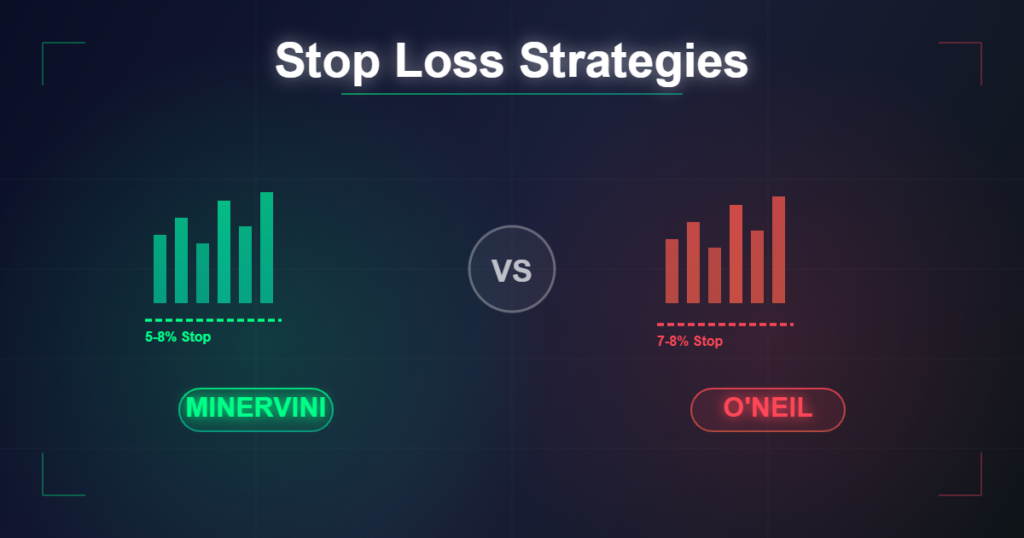
1. The 5%–8% Maximum Loss Rule
Minervini’s most famous rule is simple but brutally effective:
Never allow a stock to fall more than 5%–8% below your purchase price.
- 5% stop for tight, low-volatility bases
- 7–8% stop for slightly volatile setups
This rule ensures that no single trade can significantly damage your portfolio.
2. Stop Loss Based on Technical Structure
Minervini does not blindly apply percentages. He aligns stops with:
- The low of the base
- A key pivot or breakout point
- Rising moving averages (especially 50 DMA)
If the stock violates structural support, the trade thesis is invalid.
3. Volatility Contraction Matters
Stocks with tight volatility allow tighter stops. Wide and sloppy bases require wider stops—or should be avoided altogether. This is why Minervini prefers VCP (Volatility Contraction Pattern) setups.
Learn more directly from Minervini’s work here by clicking: 👉 Mark Minervini Official Website
William O’Neil’s Stop Loss Method (The Absolute Discipline Rule)
William O’Neil, founder of Investor’s Business Daily and creator of the CAN SLIM strategy, popularized the most widely followed stop-loss rule in growth investing.
1. The Hard 7%–8% Rule
O’Neil’s rule is non-negotiable:
Sell any stock that falls 7%–8% below your purchase price—no exceptions.
This rule applies regardless of:
- Market conditions
- News
- Your conviction level
Why? Because O’Neil studied over 100 years of market history and found that most super losers started with small losses that investors refused to cut.
2. Stops Are Placed Immediately
O’Neil emphasizes placing mental or actual stop losses the moment you enter a trade. No delays, no adjustments based on emotions.
3. No Averaging Down—Ever
If a stock hits your stop, it’s sold. Period. Averaging down is considered a cardinal sin in O’Neil’s framework.
More on CAN SLIM and O’Neil’s philosophy: 👉 Investopedia – CAN SLIM Strategy
Minervini vs O’Neil: Key Differences
| Aspect | Mark Minervini | William O’Neil |
| Stop Type | Dynamic & structural | Fixed percentage |
| Loss Range | 5%–8% | 7%–8% |
| Flexibility | High | Very strict |
| Volatility Consideration | Yes | Limited |
| Averaging Down | Never | Never |
Both approaches reinforce How to Set Stop Loss Like a Pro, but Minervini adapts more to price behavior, while O’Neil enforces absolute discipline.
Common Stop Loss Mistakes Retail Traders Make
Even traders who know the rules fail in execution. Here are the biggest mistakes:
1. Placing Stops Too Wide
Wide stops feel safer emotionally but destroy risk-reward math.
2. Moving Stops Lower
Once a stop is set, moving it lower converts a trade into a hope-based investment.
3. Ignoring Market Context
Both Minervini and O’Neil stress that most stocks fail when the market trend is weak. Stops trigger faster in bad markets—and that’s a feature, not a bug.
4. Emotional Attachment
Professionals see stocks as symbols, not stories.
How to Set Stop Loss Like a Pro: A Practical Framework
Here’s a step-by-step process inspired by both legends:
- Identify a clean base or breakout
- Define invalidation level (base low / pivot)
- Ensure loss is within 5%–8%
- Place stop immediately after entry
- Never widen the stop
- Trail stops upward as price advances
This hybrid method captures the best of both worlds and reinforces How to Set Stop Loss Like a Pro in real trading conditions.
Trailing Stops: Locking in Gains
Once a stock moves 20%–25% in your favor:
- Minervini suggests trailing stops using moving averages
- O’Neil suggests partial profit booking and defensive stops
Trailing stops convert paper profits into realized gains while keeping you in powerful trends.
Psychology: Why Stops Are Hard but Necessary
Losses hurt more than gains feel good. This psychological bias causes traders to delay exits. Both Minervini and O’Neil designed their stop-loss rules to override human emotion with structure.
If you master How to Set Stop Loss Like a Pro, you master the mental side of trading.
Final Thoughts: Risk Control Is the Real Edge
There is no holy grail strategy—but there is a holy grail principle: capital preservation. Mark Minervini and William O’Neil didn’t succeed because they were right more often; they succeeded because they lost less when wrong.
If you internalize and execute How to Set Stop Loss Like a Pro, you give yourself the one edge that never goes out of style: survival.
For further reading on risk management basics: 👉 Investopedia – Stop Loss Orders Explained
For more learnings from Mark Minervini, check some of my posts below:
The Art of Risk Management: 5 eye opening lessons from Mark Minervini
5 Powerful Insights into Mark Minervinis Volatility Contraction Pattern (VCP)
5 Powerful Reasons Why Position Sizing Decides Profitability More Than Stock Picking
5 Powerful Reasons to Use a Risk per Trade Calculator (Free Tool)