
Position Sizing Decides Profitability more than stock picking — a truth that every serious trader eventually discovers. As Mark Minervini teaches, the secret to consistent market success isn’t finding the perfect stock but controlling how much you risk on each trade. Through disciplined position sizing and sound risk management, traders can protect capital, survive volatility, and compound wealth over time.
Most traders spend endless hours scanning for the next multibagger or perfect breakout setup. Yet, as Mark Minervini, the U.S. Investing Champion and author of Trade Like a Stock Market Wizard, repeatedly teaches, your profits are determined not by what you buy, but by how much you risk.
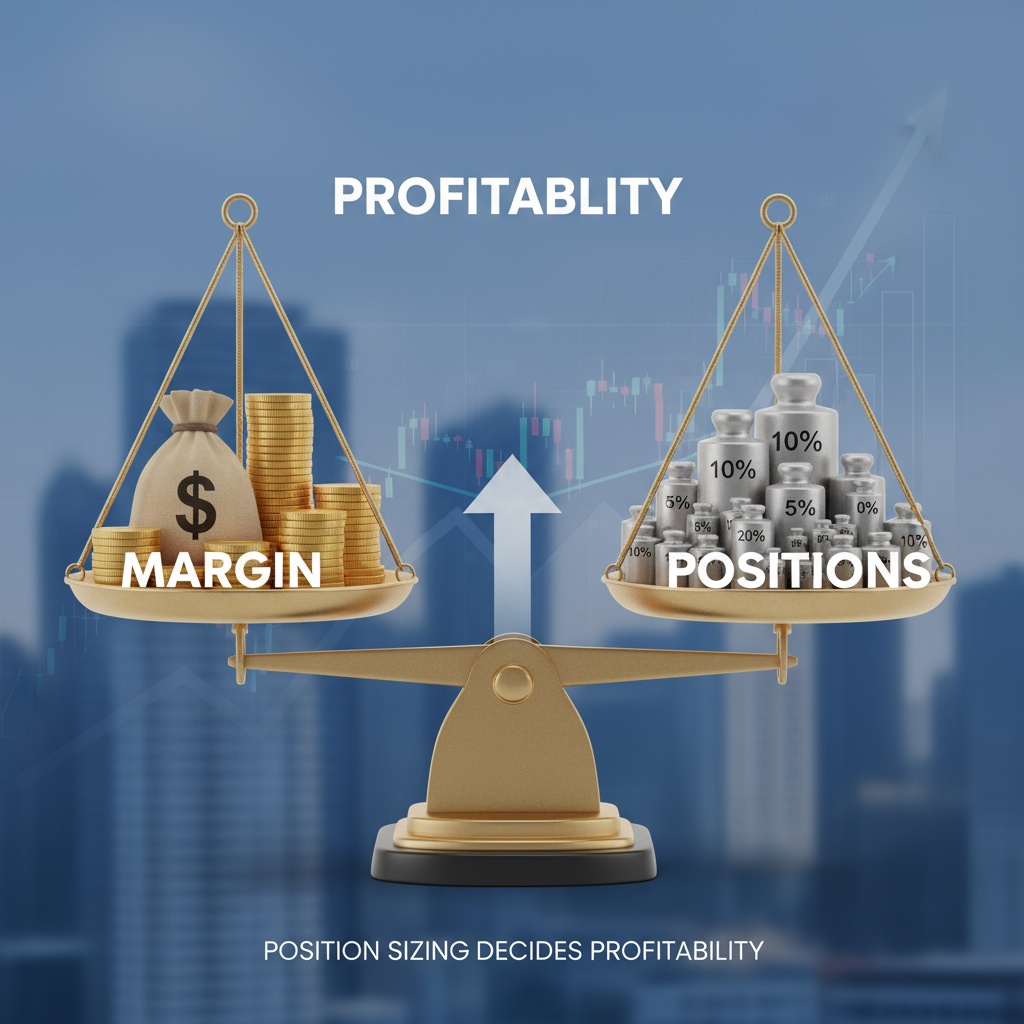
Let’s dive into five powerful reasons why position sizing decides profitability more than stock picking — and how you can use it to safeguard and grow your trading capital.
1. Position Sizing Controls Your Risk Exposure
When you understand that Position Sizing Decides Profitability, you stop treating every trade as a gamble and start managing it like a business. According to Minervini, the most important number in trading is not your profit target but how much you’re willing to lose.
If you risk 1–2% of your total capital per trade, you can withstand multiple losses without emotional stress. For example, with ₹5,00,000 capital, risking 1% per trade means your maximum loss is ₹5,000.
Even after 10 consecutive losing trades, you’d still have ₹4,50,000 — giving you plenty of capital to recover. That’s the true definition of staying in the game.
The math behind why Position Sizing Decides Profitability becomes clear when you compare the drawdown impact of different risk levels.
| Risk per Trade | Consecutive Losses | Total Drawdown | Recovery Needed |
| 1% | 10 | 9.6% | 10.6% |
| 2% | 10 | 18.3% | 22.4% |
| 5% | 10 | 40.1% | 67.0% |
The above table shows how smaller position sizes protect your capital exponentially.
2. It Helps You Survive Losing Streaks
Traders who apply the principle that Position Sizing Decides Profitability can survive even the toughest market phases with smaller drawdowns. No trader, not even Minervini, wins every trade. The difference between professionals and amateurs is how they handle losing streaks.
By sizing positions based on risk rather than conviction, you ensure no single trade can blow up your account. When your risk per trade is predefined, a losing streak becomes a statistical event, not an emotional catastrophe.
This mindset shift is what allows professional traders to stay consistent over decades.
3. Position Sizing Multiplies the Power of Compounding
Trading is not about hitting home runs — it’s about compounding small, controlled wins.
When your risk is capped but your reward is open, you create asymmetrical returns — the key to exponential growth. For instance, risking ₹5,000 to make ₹15,000 gives you a 1:3 reward-to-risk ratio. Repeat this with consistency, and your capital grows steadily while keeping downside minimal.
As Minervini says, “It’s not the big wins that make you rich; it’s avoiding the big losses.”
4. It Reduces Emotional Decision-Making
One of the main reasons Position Sizing Decides Profitability is its ability to keep emotions under control, even during volatile market moves. Position sizing is as much about psychology as it is about numbers. When you know exactly how much you’re risking, you trade with clarity, not fear.
Traders who over-size positions often panic when trades move slightly against them, leading to impulsive exits or revenge trading. By controlling position size, you control your emotions — and that’s half the battle in trading.
You can read more about this concept in Mark Minervini’s official blog (DoFollow), where he often discusses the psychology of loss control and mindset management.
5. Stock Picking Only Works When Combined With Proper Sizing
Remember, even the best stock setups fail if the sizing is wrong. That’s why Position Sizing Decides Profitability, not the stock itself. Picking good stocks is important — but it’s not enough. Even the best setup can fail due to unforeseen market events. That’s why great traders combine technical skill with strict position-sizing discipline.
As Mark Minervini explains, every trade should have a calculated risk, a defined stop-loss, and position size adjusted according to volatility.
For example, in a low-volatility setup, you can allocate 15% of your portfolio; in a volatile breakout, you might go only 5%. This keeps your overall portfolio risk balanced, regardless of individual trade behavior.
For a practical overview, you can refer to Investopedia’s guide on Position Sizing (DoFollow), which details how traders can calculate their position based on account equity and stop distance.
Key Takeaway: Position Sizing = Survival + Profitability
In short, Position Sizing Decides Profitability because it defines both your longevity and consistency in the markets. In trading, stock picking gives you opportunity, but position sizing gives you longevity. Without disciplined risk control, even the best ideas are meaningless.
Mark Minervini’s philosophy is clear — protect your capital first; profits will follow naturally.
By implementing proper position sizing, you transform your trading from emotional gambling to mathematical precision — where consistency, not luck, drives your wealth.
For more learnings from Mark Minervini, check some of my posts below:
The Art of Risk Management: 5 eye opening lessons from Mark Minervini
5 Powerful Insights into Mark Minervinis Volatility Contraction Pattern (VCP)